Showing posts with label 5 stars. Show all posts

Monday, June 1, 2026

Book Club: Blueprint for Revolution--Introductory Discussion

The book cover for Blueprint for Revolution by Srdja Popovic with the words "Introductory Discussion" above the image all on a yellow background
*Items marked with an asterisk are affiliate links. I may receive a small commission at no cost to you if you purchase through these links. Thank you in advance!

Welcome to our first discussion thread for Blueprint for Revolution: How to use rice pudding, Lego men, and other nonviolent techniques to galvanize communities, overthrow dictators, or simply change the world by Srdja Popovic!

You can buy the book here or from your favorite book shop*: https://bookshop.org/a/8639/9780812995305

Let’s look at the cover, preface, and illustrations of Blueprint for Revolution before we begin digging into the book.

The cover image of the edition I have (and in the images for these posts) shows a person preparing to throw a bouquet of flowers and the text mentions rice pudding and Lego men.

As we’ve seen even in the last year, non-violent means of protest are not uncommon – consider the Portland Frog Brigade which has spread the idea of wearing frog and other inflatable costumes to anti-ICE protests around the United States as a means of non-violent protest. Bringing whimsy to protests also brings media and community attention which translates to pressure on those being protested and the regimes that support them.

When it comes to flowers, specifically, there’s a famous image titled “Flower Power” taken by The Washington Evening Star newspaper photographer Bernie Boston on October 21, 1967 at the March on the Pentagon protest related to protesting the Vietnam war. The image shows a protester inserting carnations into the barrel of a rifle held by a soldier. Others also were placing flowers in the rifle barrels, but this particular image was nominated for a Pulitzer Prize in 1967. Initially, the photograph was not given much attention until it was entered into a photography contest and then became a popular symbol of peaceful protest.
Flower Power image taken by Bernie Boston showing a person putting flowers in the ends of soldier's rifles
Flower Power photograph by Bernie Boston, taken during the March on the Pentagon,
 October 21, 1967, Wikipedia

Many of you have probably heard the phrase “flower power”, but you may not know where it began. In 1965, poet/writer, Allen Ginsberg wrote an essay called “How to Make a March/Spectacle” in which he stated to hand out “masses of flowers” as a means of fighting violence with peace. He advocated giving flowers to those in power, the police, the press, and more. The phrase “flower power” quickly became popular, particularly related to peacefully protesting the Vietnam war. It spread quickly from Berkley, California to the rest of the nation even though Ginsberg didn’t actually use the exact phrase in his essay.

Learn more about the iconic photo here:
https://en.wikipedia.org/wiki/Flower_Power_%28photograph%29

You can read more about Ginsberg’s ideas and essay here:
https://1965book.com/2014/11/05/november-19-the-berkeley-barb-publishes-allen-ginsbergs-essay-demonstration-or-spectacle-as-example-as-communication-or-how-to-make-a-marchspectacle-which-extols-the-use-of-flowers-in-pro/

You can learn about Popovic’s group, Otpor! here: https://www.nonviolent-conflict.org/otpor-struggle-democracy-serbia-1998-2000/

Other than flowers and frog costumes, are there examples of non-violent resistance that you can think of?

Is there a form of non-violent protest or resistance that you practice, no matter how big or small?

In terms of the bullet points on the back cover, is there one point you are most interested in learning more about?
The bullet point list from the back of Blueprint Revolution
Leave your thoughts in a comment or find the post on my Facebook page and join the discussion there.

Monday, June 2, 2025

BANNED BOOKS: Nineteen Minutes by Jodi Picoult

The book cover of Nineteen Minutes by Jodi Picoult with a school desk and chair knocked over and the words banned books nineteen minutes by Jodi Picoult and book review overlaid onto the image


Earlier this year, a small group of friends and I decided we wanted to read some banned books. I suggested the most banned books across the United States: Nineteen Minutes by Jodi Picoult.

According to Pen America, this novel is one of 19 that has been banned in 50 or more school districts with the following four books being the next most frequently banned:
Nineteen Minutes, in fact, was banned 98 times in the 2023-2024 school year. Looking for Alaska was banned 97 times. More than 80% of all book bans (not just the titles I've noted) appear to come from Iowa and Florida. Texas and Utah also came up regularly in the articles I read for this post.

In the case of Picoult's book, nearly every ban is focused on a single page and a single depiction of date rape. They are not at all focused on the fact that the book is about a school shooting in which ten students die and many more are injured. Nor are they focused on the fact that the entire novel centers on a student having been brutally bullied his entire life.

Think about that. ONE PAGE depicting a teenage girl being date raped is the reason for objections to this very long novel. The edition of the novel I read was published in 2013 and is 656 pages long.

ONE PAGE is the focus of nearly every ban of this book. 

A violent video game and description of human characters in the game being slaughtered in a school shooting was not the cause of objection.

A student being mercilessly bullied--even having his pants and underwear pulled down in a school cafeteria and numerous students seeing his penis, which Picoult describes--was not the subject of the objections.

Cold and calculated planning of a school shooting by one student was not the reason for objections.

Blood, injuries, and death of multiple students did not merit all of these objections.

A heavily implied suicide by one character and an explicitly stated plan by another character was not the subject of all of these objections.

Instead, it comes down to one page depicting a date rape that is not nearly as graphically described as the penis of the boy who is subjected to bullying. 

As with pretty much all book bans, I have to wonder how many of those proposing or supporting such bans have actually read the material to which they object. 

I want to encourage you to pick up and read Nineteen Minutes or one of the numerous other books regularly facing bans. 

Picoult's book was long, but it was engaging and I saw myself, at various points, in many of the characters--the parents, the popular girl who felt like an imposter, the teachers trying do right by their students, the boy who was bullied until he couldn't take it anymore. I found myself identifying in some way with most of the characters except for the group of bullies. 

There were parts of the novel that were hard to read due to how emotionally raw and painful they felt, but this was an extremely well written and thorough depiction of modern high school and modern teenage life. It carefully wove together the complicated relationships of students, parens, and community members amid a tragedy, the events leading up to it, and the aftermath. It also laid bare some of the most difficult aspects of being a parent and how parents never truly know their children's deepest thoughts and feelings--even if we experienced similar situations in our own youthful years. 

Nineteen Minutes by Jodi Picoult is a moving, but dark novel with a compelling story to tell. I hope you will read it and report back with your thoughts afterwards. 


You can purchase a copy of the book through Bookshop.org HERE.

Sources Linked:

Monday, May 26, 2025

My favorite books year by year: 2016 to 2024

Image of three closed books standing up side by side with flowers sticking out of the tops and the words My favorite books year by year 2016 to 2024

Behind the scenes, I am working on significant updates across my blog, but I thought it would be fun to list my favorite books from each year since I started keeping track of my reading in 2016.

Leave a comment and let me know what your favorite books have been over the years!

2024: Moon of the Crusted Snow by Waubgeshig Rice

2023: Good Neighbors by Sarah Langan

2022: An American Marriage by Tayari Jones

2021: The Push by Ashley Audrain

2020: The Friend by Sigrid Nunez 

2019: Eleanor Oliphant is Completely Fine by Gail Honeyman

2018: A Man Called Ove by Fredrik Backman


2016: The Vegetarian by Han Kang

There were a few years where it was hard to narrow my favorite down to just one book.

Have you read any of these? What did you think of them?

Tuesday, January 16, 2024

Book Review: Seven Empty Houses by Samanta Schweblin

Must Read Short Story Collection book cover from Seven Empty Houses by Samanta Schweblin featuring a distorted yellow door on a sage green background

As I write this, I am sitting in a friend's apartment in Buenos Aires, Argentina. I'll be in Argentina for an entire month, and as I noted in THIS post, one of my reading strategies is to choose a theme -- for January, I decided that my theme would be Argentinian fiction. 

Please note: links may be affiliate links in nature. Your purchases through these links may result in small commissions for me at no extra cost to you. Thank you in advance! Book links are to Bookshop.org.

At the start of January, I chose four books:
(I tried to include the accent symbols in the author names, but my computer and/or Blogger wouldn't cooperate!)

The first book I finished is the short story collection, Seven Empty Houses by Samanta Schweblin -- winner of the National Book Award for Translated Literature in 2022. Not only did this book fit my theme, but by being short stories, I also felt like I was accomplishing some reading goals with every short story that I finished which, in turn, helped to keep me reading. 

Schweblin's book is seven short stories in which something is missing or lost or fading away. Each of them is deeply rooted in realism with an edge that cozies right up next to magical realism. Magical realism is deeply rooted in Latin American literature and deeply tied to Argentinean literature specifically, primarily starting in the 1940s. 

The short stories in this collection are at times disorienting -- one centers on a woman and her incredibly lonely descent into dementia. Another focuses on a young girl who finds herself alone amidst a family emergency and a meeting with someone that feels at once sinister and exhilarating. Another involves possible ghosts. Then, there are the choices made -- or not made -- between spouses that leads to a sense of loss.

Each story feels complete in and of itself, but each also is dark and somewhat mysterious without falling into the magical aspects of magical realism. Most of the stories feel highly modern, though a couple could be set across a few time frames from the last 100 or so years. 

These are truly stories of loss and emptiness, as suggested by the collection title. According to the reading app, The StoryGraph, my reading preferences are typically reflective, emotional, sad, and dark -- Seven Empty Houses by Samanta Schweblin, definitely fits with these unconscious preferences, particularly the story about the woman with dementia. I highly recommend this collection!

What are you reading? Is it part of a larger theme that you've chosen? Share in a comment!

Must Read Short Story Collection book cover from Seven Empty Houses by Samanta Schweblin featuring a distorted yellow door on a sage green background

Must Read Short Story Collection book cover from Seven Empty Houses by Samanta Schweblin featuring a distorted yellow door on a sage green background


Wednesday, November 22, 2023

BOOK REVIEW: We All Want Impossible Things by Catherine Newman

Book cover with a soda can used as a vase with daisy in it but also with a straw on a blue background
(Links are affiliate in nature. I may receive a small commission or payment at no extra cost to you if you make a purchase through these links. Thank you in advance!)

Years ago, my mom was in a reading rut and asked me for some book suggestions -- like me, she was a voracious reader. It was rare for my mom to find herself in a lull with reading, so I happily supplied a list of 10 books or so and she started in on it. 

After the first three books on the list, my mom came to me and said that she appreciated the list, but she'd no longer be reading from it and would not take reading suggestions from me again.

Her reason? Most of what I like to read is "depressing and sad", according to my mom. That has not changed over the years. 


This novel is devastating but beautiful.

We All Want Impossible Things is about love, loss, and grief, as well as motherhood and friendship. It really highlights that we are all human and reminded me a lot of something one of my high school English teachers said (she was quoting the author, Wally Lamb, I believe): "The best fiction is often more true than real life." This book was so true to my experience of grief and loss that it definitely felt more true than real life! I've had a lot of heart break over the last few years, and this novel helped to mend some of it.

This book made me cry a lot, but despite being so sad, it also made me laugh quite a bit!

We All Want Impossible Things is about a woman whose best friend is in hospice and how she navigates that alongside being a single mom to a teen daughter and a college aged daughter, while still being in love with (and also not in love with at the same time) her ex-husband, and while trying to figure out her own life.

If you enjoy the work of Anne Lamott, particularly the novel Rosie, you'll like this one. It's equal parts sad and funny. My mom would still would have found it depressing.

I found We All Want Impossible Things to be deeply satisfying. It is filled with all the ups and downs of relationships in many areas of our lives, includes good food, cozy living rooms, sex without being gratuitous, awe and wonder at the world around us, and so much more. I will definitely read this one again!

Buy it on Bookshop.org HERE.
Buy it on Amazon HERE.


Monday, March 13, 2023

BOOK REVIEW: No Land to Light on by Yara Zgheib

Book Review: No Land to Light on by Yara Zgheib
Links are affiliate in nature and may result in a small commission for me if you purchase through them. Thank you in advance!

No Land to Light on by Yara Zgheib is by far one of the best books I've read in a very long time (in addition to Good Neighbors by Sarah Langan).


This book combines so many emotions: hope, sadness, worry, outrage, love, tenderness, and more!

No Land to Light On features shifting points of view between the two main characters with news editorials sprinkled throughout. The book is the story of a Syrian refugee who has become a legal US resident who falls in love with a Syrian woman who immigrated to the United States in order to attend college at Harvard. They marry and eventually find that she is pregnant. 

The young couple endures the ups and downs of navigating growing love and the prospect of becoming parents while also working through different experiences and different levels of comfort within the United States -- she is far more comfortable and wholeheartedly embraces her new status as an American. he clings to his Syrian roots while feeling the pull of a new way of life. 

Sama left behind bitterness and ran towards opportunity. Hadi left behind parents, friendships, and a love of the land and his father's orchards. He also left fear and violence as he moved towards the promise of freedom and a chance to start over in America, but clouded with fear of the unknown.

Upon the death of his father, Hadi returns to his homeland for the funeral. Little do they know that his attempted return to his legal home in the United States will coincide with a travel ban that includes Syrians -- even if they are legal residents of the United States. 

As Sama awaits his return at the arrivals section of the airport, amid the chaos of protestors, she goes into premature labor and starts her own harrowing journey. 

No Land to Light On by Yara Zgheib, published by Simon & Schuster, is beautifully written, despite the sometimes difficult topics. 

Up next, expect a review of the classic book Animal Farm by George Orwell.

Purchase No Land to Light On by Yara Zgheib:


Sunday, February 26, 2023

January and February 2023 Reading Roundup

January and February 2023 Reading Roundup

So far, in January and February of 2023, I've read far more than in the same time period the prior few years! 

In part, I've been making a conscious choice to sit down with a book instead of mindlessly scrolling or watching TV. I've also just been far less stressed than in the last few years, so it's been more natural to pick up a book without having to make a conscious effort. 

Links within the body of this post are affiliate links for Bookshop.org. Links at the end of the post are from Amazon.com. Either way, these may result in a small commission for me if you make purchases through these links. Thank you in advance!

In January, I finished:
In February, I finished:
  • Cold by Mariko Tamaki (young adult fiction; murder mystery)
  • The Last Chance Library by Freya Sampson (Contemporary British fiction; chick lit; Rom-Com; lighthearted and sweet)
  • Good Neighbors by Sarah Langan (Contemporary American fiction; psychological thriller; family and friend relationships; near future climate crisis)
As of this writing -- the second to last day of February -- I am currently working my way through:
I have several other books in progress from months past, but these three are at the top of my list.

So far, the best book I've read in 2023 is Good Neighbors by Sarah Langan. Whoa! This book is tense, but I could not put it down! The book takes place in the near future amid a growing climate crisis that is making life nearly unbearable in what is an otherwise very typical suburban United States neighborhood. As the story unfolds, we see relationships  shift between a group of neighbors and their children. The kids are growing up and shifting allegiances. The parents are mostly trying to hold their lives and families together with varying degrees of success. Ultimately, everything unravels when one of the kids disappears into a sink hole. Cracks in all of the relationships -- family units, friends, and so on -- begin to form and unthinkable acts of violence occur under the cover of darkness. Although this was a devastating story, it was also exceptionally written and I highly recommend it.

What has been your best read so far in 2023?


Friday, January 29, 2021

BOOK REVIEW: Know My Name by Chanel Miller

BOOK REVIEW: Know My Name by Chanel Miller
Know My Name
by Chanel Miller was by far the best book I read in 2020 (followed closely by Homegoing by Yaa Gyasi). Miller's book is a memoir about her experience as a sexual assault survivor, including the attack, the court case that followed, and rebuilding her life after physical, emotional, and mental trauma. 


I particularly enjoyed Miller's ability to weave memories of earlier times in her life into her telling of what happened to her. She is a master story teller, even when it comes to the awful, most horrifying bits. Miller's memoir is filled with both vulnerability and strength. At times I found myself openly weeping and crying while at other times I cheered and smiled large at her ability to find joy amid the depths of despair. 

After being attacked by Brock Turner on the Stanford University campus in 2015, Miller sunk into a deep depression that was only made worse through the madness of the criminal justice system. Instead, however, she fought her way back to herself and rebuilt her life. It is clear from her memoir though, that this also entailed dealing with long lasting trauma that may follow her and inform her choices and thoughts and overall being for the rest of her life. She chose over and over to not give in. She chose over and over to experience life and explore her interests. That's not to say it was easy and that's not to say she didn't go through periods where she did want to give up, where she did succumb to her fears and dark thoughts. But, she always climbed back out of the depths. 

Included in the memoir is Miller's victim impact statement which is a masterpiece that no one should ever have to write. It is a masterclass in how not to rape, how not to assault, how not to behave, how not to treat others. 

Miller's assault was not that long ago, but I am sure it will have a lasting ripple effect on her life, the lives of her sister and parents, on her friends, and others. I'm sure the intensity has and will continue to dial down over time, but the assault and all that came with it will always still be there, like a little grain of something in their shoes that they forgot about for the longest time. Then it shifts, and they feel it with every step until they try to remove it, but can't find it. It shifts again and they move on and don't feel it -- even forget about it again until, one day, there it is yet again. 

Every now and then Miller's attacker comes up in the news and do not feel a single bit sorry for him when the news is related to him having a hard time in life. He brought that upon himself. 

Rather than rewrite things I've already written, the rest of this post is primarily from comments I made in a small book group myself and three good friends read Know My Name. I've only edited a little bit for clarity and length. 

This was such a hard book to read, but I'm so glad that I did! I'm so glad I bought it instead of getting it from the library. I'll read it again, but not anytime soon. I know I'll recommend it to many people in years to come too. 

I'm struck by similarities with the Netflix short series "Unbelievable" which is excellent and based on real rape cases near Seattle and in Colorado. In both Miller's book and the Netflix show, there seems to be a clear division in the way men handled and treated victims compared to how women responded. There are some women who will take the "what were you wearing/doing/drinking" or "you should have kept your legs closed" stance and also some women who get embarrassed or don't want to to be involved in such intimate invasions, but I see it far more in men both in media and in life. It's unfortunate since men can be excellent allies -- and they aren't exempt from being victims as well. 

Women are constantly held to double standards from birth and both Miller's book and "Unbelievable" highlight that fact. As I was finishing Know My Name, I also was reading the poetry collection Wild Embers by Nikita Gill which was the perfect compliment to Miller's memoir. The poems feature themes about the double standards women are held to, about boys and men being given a pass for bad behavior because of the idea that "boys will boys", and how women are forced into the defensive position when we deserve to stand strong and not to be subjected to abuse. 

I loved Miller's book (and "Unbelievable" and Wild Embers), but it provokes a strong emotional response as a reader and was difficult, at times, as a result. I was struck by Miller's ability to create vivid images and to craft metaphors while mining the depths of her memories and lived experiences to create context, emotions, and so on.

I hope you'll consider reading Know My Name by Chanel Miller. I think about it regularly even though it's been months since I read it. 

You can buy a copy of Know My Name on Bookshop HERE.
Or find it on Amazon HERE
Or look for it at your local library. 

As of my writing this, "Unbelievable" is available on Netflix HERE.

You can find Wild Embers by Nikita Gill on Bookshop HERE.
Or on Amazon HERE.
Or try your local library.

Please note: links may be affiliate in nature. Making purchases through such links may result in a small commission to me at no cost to you. Thank you in advance. 


Wednesday, January 27, 2021

BOOK REVIEW: The Kissing Hand by Audrey Penn

BOOK REVIEW: The Kissing Hand by Audrey Penn
In 2021, I'm participating in a children's literature reading challenge hosted by Mrs. Sarah Collier of Belle's Library and the Victorian Letter Writers Guild

Portions of this post also appear on my parenting blog: Mom2MomED
in a post called 7 Ways to Use The Kissing Hand by Audrey Penn.
Read the full post HERE.

My inaugural book for the Children's Literature Challenge is The Kissing Hand by Audrey Penn. My child (now an adult) and I first received this book as a gift from my mother several years ago when my kiddo was still quite young. 
On my parenting blog, I share 7 ways to use this book with your children (read the post HERE), but in this post, I am going to focus more on the book itself. I mean, look at these illustrations? The book is GORGEOUS!
My mom was a kindergarten teacher and bought many beautiful books for my child over the years, but The Kissing Hand is one that we returned to over and over. The story and premise are pretty simple but also familiar to pretty much every parent ever -- a child is scared and nervous about going to school for the first time and the parent tries to find a way to make it ok. In this case, mama racoon helps her child to overcome fear and anxiety by kissing the child's palm as a reminder that she's always there even if she's not physically present. 

The Kissing Hand was instrumental in helping my child and I adjust to the emotional turmoil that comes with going back and forth between divorced parents (read about my suggested books for divorce HERE). Although the book is the story of a child going to school for the first time, it easily is applied to any form of temporary separation between parent and child.

I loved reading through this book again and thinking about my mom -- she has dementia, but she still loves a kiss from one of her children or grandchildren -- and my child, now an adult. The story is lovely and the illustrations are beautiful. The animals, trees, and other aspects of nature are beautifully rendered throughout. 
Over the years, I've bought copies of The Kissing Hand for friends navigating divorce with young children and many have started their own kissing hand traditions to help their children navigate going back and forth between parents' homes.  

The Kissing Hand by Audrey Penn and illustrated by Ruth E. Harper and Nancy M. Leak, is such a lovely and sweet book. I hope you'll pick up a copy for a child in your life.  

Grab a copy on Bookshop HERE.
Grab a copy from Amazon HERE.
Or, hit up your local library.

This post may include affiliate links ~*~ making a purchase through these links may result in a small commission to me at no cost to you. Thank you in advance. 


Monday, December 14, 2020

3 books to help your kids (and you) cope with divorce

3 books to help your kids (and you) cope with divorce
Please note, this is cross posted at my parenting and education blog, Mom2MomEd.
 
Divorce isn't easy for anyone, but it can be especially hard for our children who may not have the maturity or vocabulary to understand or talk about what is happening in their family. It is hard for kids who may feel insecure, who may worry that they are unloved, who may think the divorce is their fault. 
 
It's obviously hard for parents too. 
 
And, the difficulties on both sides -- parent and child -- can make talking about divorce and making your and their way through it difficult. Books can help. 
 
My son was 4 years old when his father and I separated, and it was hard on all of us, but especially on JP. My priority was making sure that he understood that he was loved and wanted and that he had a safe way to explore and express his feelings. I spent a few hours at my local bookstore, looking at children's books about divorce and changing families and brought home the following books -- the first two are specifically for children and the third is for parents.
 
I will be honest, my son wasn't always in the mood to have these books read to him or to read them with me. Sometimes he was just mad and wanted to stomp around and be angry or to curl up in a ball and cry. But, I would calmly remind him, "Hey, I know you don't want to read these books right now, but I also know that when we do read them together, you always end up feeling better. You start smiling and relaxing and we can talk about what you're feeling and thinking about afterwards. It's OK if you just want to curl up in a ball while I read to you, or I can rub your back, or you can pace around and just listen."
 
Most of the time, he'd curl up next to me or in my lap or he'd want me to rub his back while we read, and almost every time, he would feel better -- and he'd recognize that too. We read each of these books dozens of times from the time he was 4 years old until about 7 years old, and they truly helped both of us to navigate difficult emotions and conversations.
 
If your family is going through divorce or separation or you know a family that is, I hope these books will help you or them too. 
My Family's Changing: A First Look at Family Break-Up by Pat Thomas and Lesley Harker
 
This sweet book combines a story with discussion prompts. You can read it straight through as just a story, you can stop at each discussion prompt as you go, or you can stop at one discussion prompt and set the book aside while you talk things through.
 
The illustrations combined with the story and the prompts helped my son to feel like he was seen and heard amidst the grown up problems. The prompts are especially great if you aren't sure how to talk to your child about divorce or a family break up. 
 
There's an entire range of books in the series from topics such as family dynamics to bullying to inclusion and diversity and more. 
  • Buy My Family's Changing on Bookshop HERE.
  • Buy My Family's Changing on Amazon HERE.
 
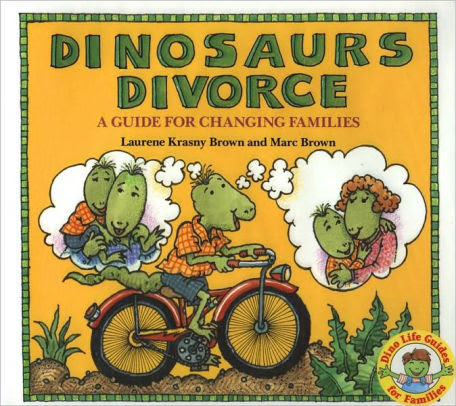
Dinosaurs Divorce by Marc Brown and Laurie Krasny Brown
 
Like My Family's Changing, Dinosaurs Divorce helps kids navigate the ups and downs and new normal of divorce and changing families. And, if the dinosaurs look somewhat familiar, it's because Marc Brown is also responsible for the Arthur books and cartoon series. Of all the books we had about divorce -- and we had many -- this is the one we read the most.
 
My son particularly liked this book over the others because of the dinosaurs. I think it was easier for him to view divorce through the lens of a non-human character and it was easier to approach a very real and difficult topic through very unreal/non-human characters. Children live in a magical space between reality and make believe, and they often use make believe to sort out their feelings about very real problems. Using dinosaurs in place of humans is a great way to help ease kids through such a difficult experience.
 
Also like My Family's Changing, Dinosaurs Divorce is part of a larger series of books that tackle numerous topics. One of the most popular other books in the series is When Dinosaurs Die
  • Buy Dinosaurs Divorce on Bookshop HERE.
  • Buy Dinosaurs Divorce on Amazon HERE.

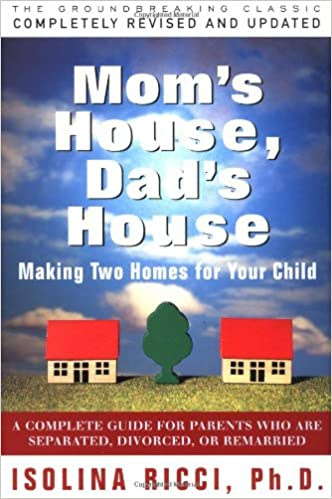
Mom's House, Dad's House by Isolina Ricci
 
This book is for the adults in a child's life, but it will help you manage your own way through the divorce or separation in a way that supports your child. 
 
One of the reasons I love this book is that it doesn't assume anything is one parent or the others fault. In fact, it offers suggestions and analysis for self-reflection to look at your own behavior and thoughts as both a parent and a divorcing or separating adult and think, "Is this thought or behavior reasonable or am I the problem in this situation?" Ricci also gives many ideas and tips and thoughtful suggestions for how to talk to children and how to work with the other parent or guardian.

Ricci's book helped me to navigate disruptive issues with my son's father and to set firm boundaries during a difficult situation. It gave me a framework for sorting out what I needed as a half of a divorcing couple but also what my son needed and how to best show up for him. It helped me to see both sides of the divorce and gave me many excellent ideas and tips to consider when it came to the overall situation, as well as for specific situations and for sorting out a parenting and custody plan. The book gave me a vocabulary to use and a way to look at things more objectively. 

I truly believe Ricci's book helped me to navigate what was best for my son, even when that sometimes conflicted with what I wanted for myself.
 
There's also a kids version of Mom's House, Dad's House by Isolina Ricci, but I have not read it or reviewed it. Have you?
  • Buy Mom's House, Dad's House on Bookshop HERE and the kids version HERE.
  • Buy Mom's House, Dad's House on Amazon HERE and the kids version HERE.

There are many, many books about divorce for parents and children, but time and time again I am led to believe these three are the best. What books do you think divorcing or separating couples should read? How about kids stuck in the middle?

Please note: links may be affiliate in nature. Making purchases through these links may result in a small commission to us at no extra cost to you. Thank you in advance!


Wednesday, December 9, 2020

REVIEW: The Antiquarian Sticker Book -- Over 1,000 Exquisite Victorian Stickers

Book Review: The Antiquarian Sticker Book
This certainly is not my normal book review! I never expected to review a sticker book, but this one -- The Antiquarian Sticker Book -- is fantastic!

Warning: this post is image heavy.

Even though I'm a middle aged woman, I still love stickers. I still get that school child jolt of glee at opening up a new sticker pack and deciding where and how to use them. And, I still sometimes think some stickers are too precious to use and I want to save them instead.


As a child, most of my stickers were used fairly randomly and often were affixed to construction paper, my own skin (usually the back of my hands or my cheeks), or were attached to handmade cards -- I was very much a rule follower growing up (and still mostly am), and would not have dared to put a sticker on furniture, a book, or anything else that might be of value or ruined by the placement of a sticker. The last several years, most of my sticker using has been reserved for letters sent to pen pals or I have used them in my journal and planner spreads. And, of course, I have the obligatory vinyl sticker assortment on my laptop cover -- don't you?

Recently, I realized my sticker collection had outgrown the small drawer in which I contain it. As such, I culled several, sending many on to a friend that had recently mentioned a desire to use stickers in her planner, and then I used several to create a rainbow theme, inspired by the professional crafter, Amy Tangerine (professional crafter = #goals), in a notebook. Even with both of those purges of my sticker collection, I still have a TON, so I put myself on a sticker buying ban.
A rainbow sticker spread inspired by Amy Tangerine
The rainbow sticker spread in my planner.

Then, the very next day, someone in a Facebook group I'm part of posted a picture of The Antiquarian Sticker Book! I was in awe of the amazing stickers between the covers -- more than 1,000 of them! They were just so beautiful that I ordered the book despite my sticker buying ban.

And, I love it! The stickers and the book as a whole are gorgeous, and I don't regret the purchase at all. Let's take a walk through some of the pages:
Front cover: The Antiquarian Sticker Book
Front Cover: The Antiquarian Sticker Book
The book's end papers are gorgeous!


There are a few page where almost the entire page is one big sticker.

The peacock is my favorite sticker in the entire book!


The stickers are fairly low-tack, meaning they aren't super duper sticky. I tested one (a sticker of a spider since I am not a fan and can't see myself ever using the spider stickers...ewwwww!), and was pleased that it was tacky enough to stick to a piece of cardstock, but not so tacky that I couldn't easily lift and reposition it. If you need to ensure that the stickers stay stuck down, use your finger to rub across the surface. A painter once told me that the friction helps. I don't know if it's really the friction or heat generated or what, but the trick seems to work on stickers and washi tape. However, if I could see a need to apply glue to some stickers if the surfaces they are going on is not paper or if they application requires that the sticker be permanently affixed. This does not bother me at all as I often use extra adhesive on stickers anyhow when I craft or if I am applying the sticker to a letter that will be folded where I've placed the sticker.
After applying a sticker to this cardstock,
I as able to peel it up with minimal damage to either.

The way the book is structured, each page features stickers on one side and a decorative backing on the other side. The backing side is the same throughout, so although the book is 1 3/16" thick, excluding the front and back covers, only half of that is actually stickered pages. 
A look inside the book The Antiquarian Sticker Book

I love the cover of this book and the backing of each sticker page so much that I plan to repurpose the book as an art journal when the stickers are all gone -- I'll do art work and collages on the sticker side of each page.

Have you bought The Antiquarian Sticker Book? If so, leave a comment and tell me which sticker is your favorite and how you'll be using the stickers.

Don't have a copy? 
  • You can buy the book on Bookshop HERE
  • Or, buy it on Amazon HERE.

Please note: links may be affiliate in nature. Purchases made through these links may result in a small commission for me at no additional cost to you. Thank you in advance!